Choosing one charger for a phone, tablet, laptop, watch, and earbuds is rarely simple. Port count alone does not reveal real charging performance. A compact charger may look powerful, yet its output can drop when several devices connect together. Heat, cable quality, protocol support, and long-term reliability also matter.
This guide examines China’s top 10 chargers for multiple devices through practical selection criteria. We consider USB-C Power Delivery, PPS compatibility, GaN efficiency, total wattage, port allocation, plug design, and safety documentation. We also compare how each charger performs in realistic situations, such as charging a laptop beside a phone during travel. Small details matter. A loose port can become frustrating quickly.
The central question is: How to select a source charger for multiple devices at the same time? A dependable answer starts with your actual device list, not attractive packaging. Check each device’s required power, then calculate whether the charger can share its output without slowing everything excessively. Look for transparent specifications, tested temperature control, and clear warranty support from established manufacturers. Independent reviews can help, but they are not always consistent. That deserves attention.
Some rankings may change as charging standards develop. A model praised today may lack newer PPS support later. We therefore balance laboratory-style specifications with everyday experience, including cable reach, portability, heat, and stability. No charger is perfect. The best choice is the safest, most practical match for your routine, budget, and devices.
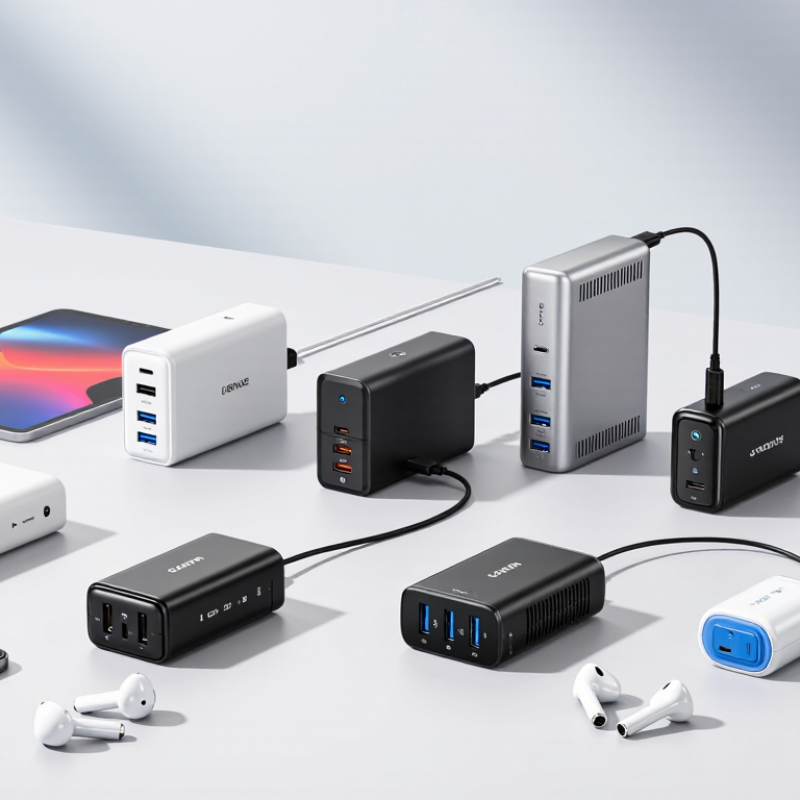
Multi-device chargers need a clear category boundary. This review covers four types: wired multi-port chargers, desktop charging stations, wireless pads or stands, and travel chargers. Products must support at least two device classes, such as phones, tablets, laptops, earbuds, or watches. Single-purpose adapters are excluded, even when their output is powerful. USB-IF’s USB Power Delivery 3.1 specification supports power levels up to 240 watts, but real performance depends on cables, thermal control, and device compatibility.
The Top 10 evaluation focuses on measurable use, not appearance. Port allocation receives attention because one laptop can reduce power available to other devices. Testing should record total output, shared-load stability, charging time, heat, idle consumption, cable quality, and protection behavior.
The Global E-waste Monitor 2024 reported 62 million tonnes of electronic waste in 2022, with only 22.3% formally collected and recycled.
Durability and replaceable cables therefore deserve practical weight. They are not decoration.
Small details matter. A charger should fit behind a desk, remain stable beside a bed, and avoid blocking adjacent sockets. Independent laboratory measurements are stronger than online ratings alone. Safety certifications, clear power labels, and warranty terms improve reliability.
The scope is imperfect. Wireless charging may reduce cable clutter, yet it can waste more energy through alignment losses. My ranking should reflect that trade-off, rather than treating every charging method as equally efficient.
A 30W charger usually handles these devices well. It stays compact for daily carrying. Laptop charging may be slow or insufficient.
Choose 65W for mixed travel. It can often charge a phone, tablet, and lightweight laptop. Shared output may reduce speed.
A 100W charger suits heavier laptops, gaming handhelds, and several active devices. It supports serious multitasking. Leave some power headroom.
Choose 140W for demanding laptops, displays, and workstation accessories. It needs careful heat control and a suitable high-power cable. It may be unnecessarily bulky.
No. The device controls its power intake. A compatible cable and charging standard still matter. More capacity can remain unused.
Look for PD 3.1 and EPR wording on the technical label. Check each USB-C port’s rated output. A high-power claim may apply to only one port.
Port count can mislead. A four-port charger may include only two high-power ports. Connect a laptop, tablet, and phone together to check real performance.
PPS adjusts voltage in smaller steps for compatible devices. Check its voltage range and current limit. A “fast charging” label alone proves little.
Connect several devices for twenty minutes on a desk. Check charging speed at 25%, 50%, and 80% battery. Watch surface temperature and cable stability.
Focusing only on maximum wattage is a common mistake. I once ignored cable length and shared-power limits. A smaller charger may fit daily use better.
Choosing a charger for several devices begins with defining the category: compact multi-port adapters for phones and tablets, high-output desktop chargers for laptops, and versatile units designed for mixed device loads. Comparing 30W, 65W, 100W, and 140W classes helps match power capacity to actual demand. Lower ratings suit mobile devices, while higher ratings are better for laptops, tablets, monitors, and simultaneous charging. When asking “How to select a source charger for multiple devices at the same time,” consider USB-C PD 3.1 support and remember that the USB-IF power ceiling is 240W.
A reliable choice should provide sensible port allocation, PPS compatibility for efficient charging, and stable total output when multiple ports are used together. Check whether the advertised power remains available under load rather than applying only to one port. Safety is equally important: look for CCC compliance, effective thermal control, overload protection, and high energy efficiency. The best charger is not simply the most powerful, but the one that delivers safe, balanced, and consistent performance for your complete device combination.

 Caiku Electronic